
Ondex · XRP Ledger guide
Compare routes for supported XRPL token swaps
Choose the source and destination asset, verify each issuer, compare current route alternatives and review the exact transaction before signing.
Available on iPhone and Android. Last reviewed .
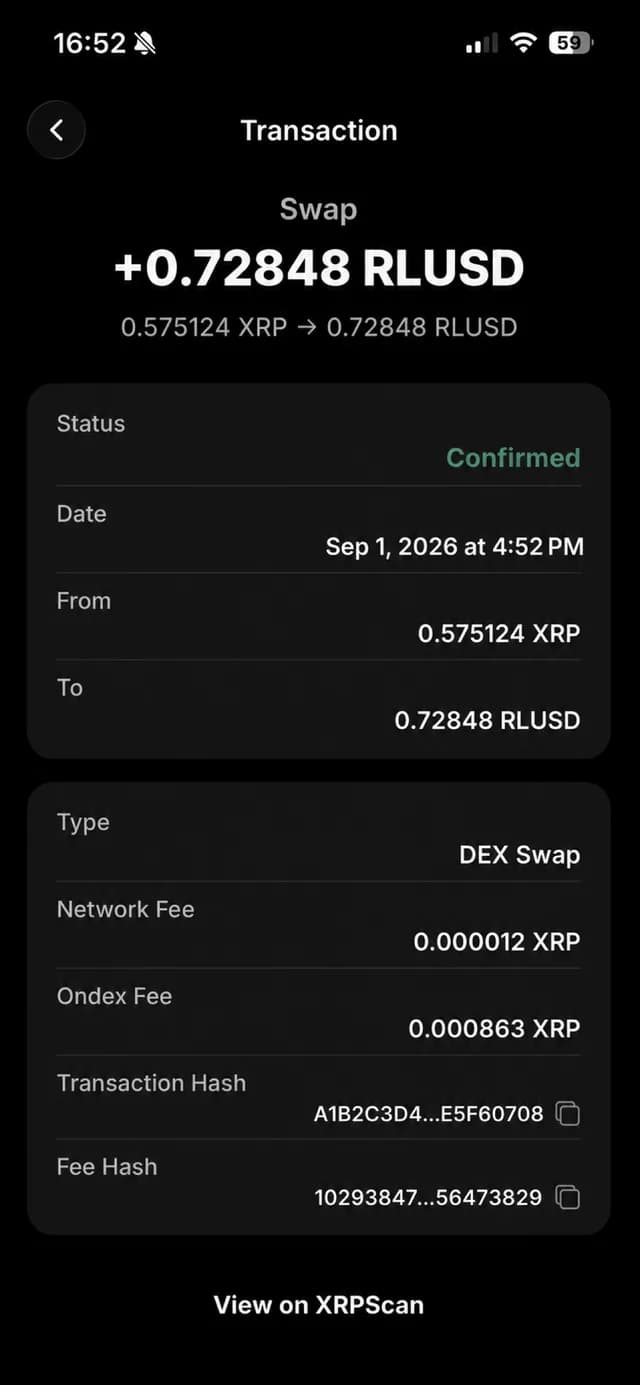
An XRPL token is currency plus issuer
For issued assets, a symbol is presentation—not canonical identity. The ledger identifies an asset with a currency code and issuer account. Two issuers can use the same code, so both sides of a token-to-token swap must be reviewed as full identities.
Ondex canonicalizes non-standard currency codes for transaction construction and keeps issuer metadata available in selection and review. A verified name is helpful context, but the issuer address remains the ledger reference.
Token-to-token routes may use an intermediary
A route can pass through XRP or another liquid asset to connect the source and destination. That does not necessarily mean the app submits multiple independent trades: XRPL path payments can represent an atomic source-to-destination intent with hard spend and receive bounds.
Review the route summary and exact transaction rather than assuming the intermediary becomes a separate balance in your wallet. If the available atomic strategies cannot satisfy the bounds, Ondex does not silently split the trade into sequential economic operations.
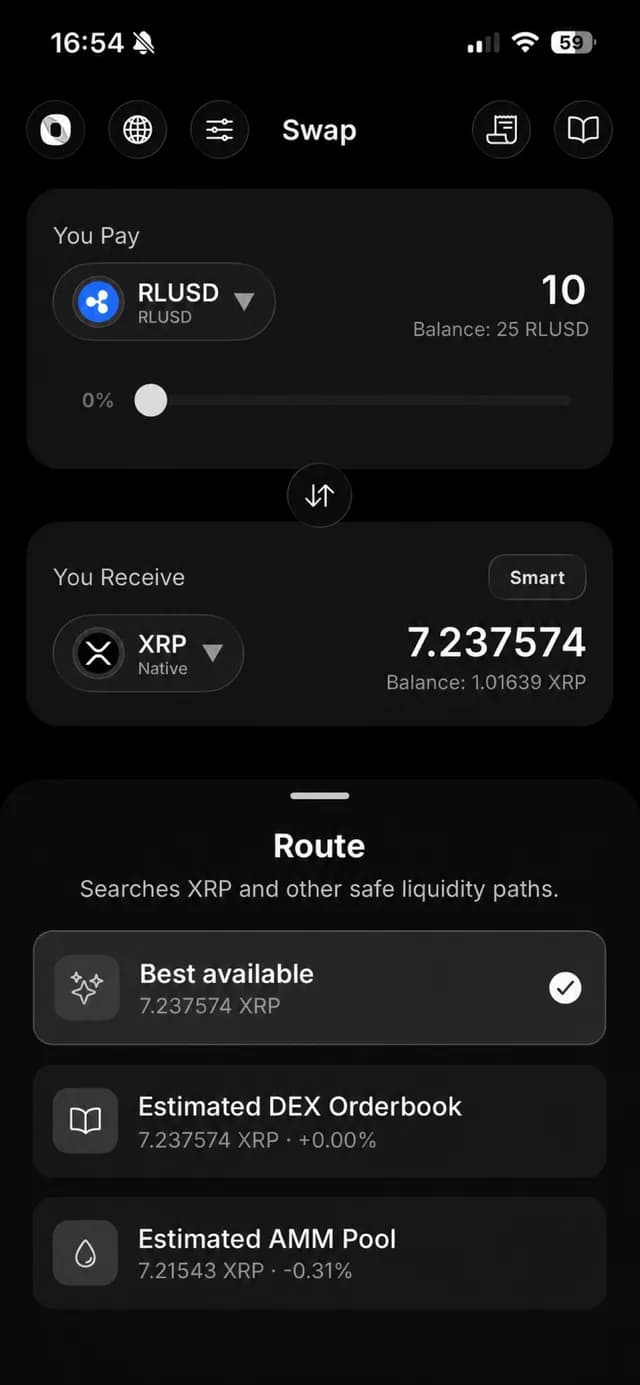
Compare order-book, AMM and valid path estimates
Smart Routing evaluates supported order-book depth, AMM output and validated pathfinding responses for the selected amount and asset identities. Each candidate must be executable, current and semantically equivalent to the intent before it can become the reviewed quote.
The comparison is time-sensitive. Thin pairs can change quickly, and a route that looks shortest is not automatically the route with the best bounded outcome after fees and price impact.
Trustlines and receive capacity
The destination account needs a trustline for most issued currencies and enough remaining limit to receive the output. A missing line can require owner reserve; an existing zero-limit line may need restoration; an insufficient positive limit may need an update. Each TrustSet also needs a network fee.
Ondex waits for the new receive capacity to appear in a validated ledger before requoting the swap. That barrier prevents a transaction from relying on trustline state that a connected node has not yet observed.
XRPL assets versus native assets on other chains
An issued asset labelled BTC, ETH or another external symbol is still an XRPL-issued obligation identified by its issuer. It is not the native asset on Bitcoin or Ethereum. A cross-chain transfer has different providers, addresses, timing and risks and is outside this XRPL swap flow.
When the asset identity or route crosses networks, use a dedicated bridge workflow and review each phase separately. Do not infer native-chain redemption from a ticker alone.
Current product evidence
See the review surface
Continue with context
Related XRP Ledger guides
Practical answers
Frequently asked questions
Primary references
Ondex for iPhone and Android
Review first. Sign on your device.
Ondex is a self-custody wallet interface. Transactions are reviewed and signed on the user's device. Network, issuer, liquidity and third-party conditions can affect availability, fees, timing and outcomes. This page is informational and not financial advice.